
Every day, billions of people use Google to search for information, products, and services. Within seconds, Google shows the most relevant results from millions of websites. But have you ever wondered how Google decides which pages deserve the top positions? The answer is Google’s algorithm.
In 2026, the search system is smarter than ever. It uses artificial intelligence, machine learning, and hundreds of ranking signals to understand what users are looking for. For website owners, bloggers, and businesses, understanding this process is essential for improving their online visibility.
What Is Google’s Algorithm?
Google’s algorithm is a complex system that analyzes and ranks web pages based on their quality and relevance. It scans billions of pages across the internet and chooses the results that best match a user’s search query.
For example, if someone searches for “best smartphones in 2026,” the search engine examines thousands of pages and displays the most useful and trustworthy results. The system considers many factors, including content quality, website speed, backlinks, user experience, and search intent.
Google updates its ranking system regularly to provide better results and reduce spam.
How Does the Search System Work?
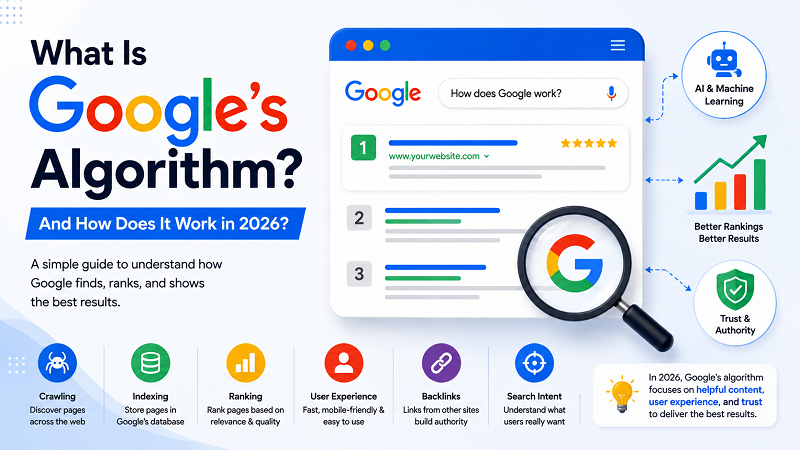
The ranking process works in three main steps: crawling, indexing, and ranking.
Crawling
Google uses automated programs, known as bots, to discover websites on the internet. These bots visit pages, read their content, and follow links to find new information.
If a page cannot be crawled, it may never appear in search results.
Indexing
After discovering a page, the search engine stores its information in a huge database. This process is called indexing.
Only indexed pages are eligible to appear in search results. Website owners often use Google Search Console to check whether their pages have been indexed properly.
Ranking
When a user enters a search query, the system compares millions of pages and decides which ones deserve the top positions.
The ranking process is based on many signals, but the main goal is simple: provide the most helpful answer to the user.
The Most Important Ranking Factors in 2026
Search rankings depend on many different factors. Here are some of the most important ones.
Helpful and Original Content
Content remains one of the biggest ranking factors in 2026. Websites that publish useful, unique, and informative content have a better chance of ranking higher.
Good content should:
- Answer the user’s questions.
- Be easy to understand.
- Provide accurate information.
- Include useful examples.
- Offer real value.
Content written only to manipulate rankings usually performs poorly.
User Experience
A good user experience is essential. Search engines want users to enjoy browsing websites and quickly find the information they need.
A high-quality website should have:
- Fast loading speed.
- Mobile-friendly design.
- Clear navigation.
- Easy-to-read text.
- Secure browsing.
Since most users now search on mobile devices, responsive design is more important than ever.
Understanding Search Intent
Search intent means understanding what the user actually wants.
For example, someone searching for “buy a gaming laptop” wants to make a purchase, while someone searching for “how to choose a gaming laptop” is looking for advice.
Pages that match the user’s intent are more likely to rank higher.
Backlinks and Website Authority
Backlinks are links from other websites that point to your site. They help search engines understand whether a website is trustworthy.
However, quality is more important than quantity. A few links from respected websites are often more valuable than hundreds of links from low-quality sources.
Guest posting, digital PR, and creating valuable content are still effective ways to earn backlinks.
The Role of Artificial Intelligence
Artificial intelligence plays a major role in modern search rankings. AI helps search engines understand language, analyze user behavior, and identify helpful content.
Because of these improvements, websites can no longer rank simply by repeating keywords. They must provide real value and answer users’ questions effectively.
AI also helps detect spam, misleading information, and low-quality pages.
How to Improve Your Rankings in 2026
If you want your website to perform better, focus on these simple strategies:
- Publish helpful and original content.
- Improve website speed.
- Make your site mobile-friendly.
- Build high-quality backlinks.
- Update old articles regularly.
- Use keywords naturally.
- Focus on user satisfaction.
Success in SEO now depends on creating content that genuinely helps people.
Final Thoughts
In 2026, Google’s algorithm is designed to provide users with the best possible search experience. It considers content quality, backlinks, user experience, and many other factors before ranking pages.
Instead of focusing on shortcuts, website owners should focus on creating useful content and building trust. Websites that help users solve problems and provide valuable information will continue to achieve long-term success in search results.